CALL +371 27 333 507 or E-MAIL info@metabend.eu

Minimum Bending Radius: Why the Same Aluminium Profile Can Bend — or Fail
This article explains why there is no universal minimum bending radius for aluminium extrusions and how profile geometry, alloy, temper, bending method, and tooling determine whether a profile can be bent successfully or will fail.
Andrejs Lukicevs
1/5/20263 min read
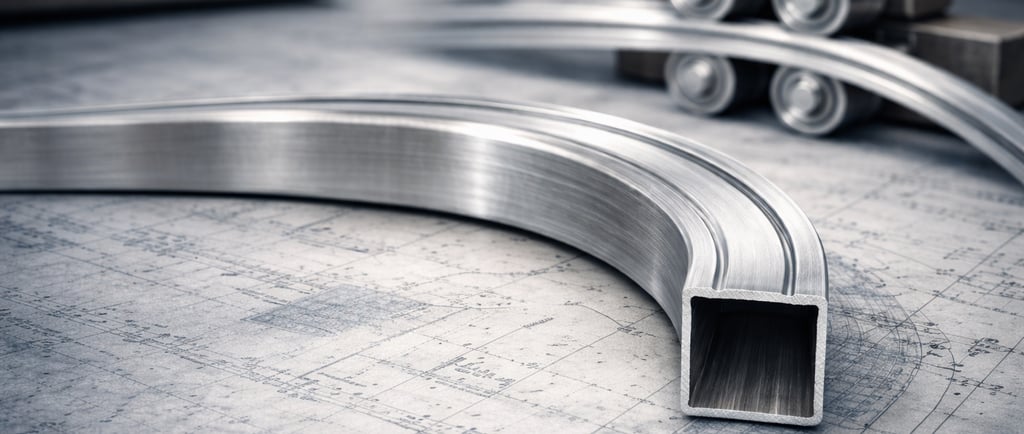
One of the most common questions in aluminium extrusion bending is deceptively simple:
“What is the minimum radius you can bend this profile to?”
At first glance, it seems like a machine-capacity question. In reality, it is an engineering question — and the answer depends on far more than the bending equipment alone. In practice, two identical-looking aluminium profiles can behave very differently during bending, even when processed on the same machine.
Understanding why this happens is critical for designers, specifiers, and buyers working with curved aluminium extrusions.
There Is No Universal Minimum Radius
Unlike sheet metal, aluminium extrusions do not have a standardized bending rule such as “X times material thickness.” The minimum achievable radius is not a fixed number and cannot be reliably determined without understanding the profile itself.
The limiting factor in extrusion bending is almost always material behavior and section geometry, not machine force. A bending machine may be capable of applying sufficient load, but that does not mean the profile will survive the deformation without cracking, collapsing, or showing unacceptable surface damage.
Profile Geometry Drives Bending Behaviour
Geometry is the single most influential factor when determining a feasible bending radius.
Key aspects include:
Wall thickness distribution
Thin outer walls experience the highest tensile strain. If these areas are too thin, cracking becomes likely at smaller radii.Open versus closed sections
Open profiles tend to ovalize, twist, or collapse more easily than closed or semi-closed sections.Internal corners and transitions
Sharp internal radii create stress concentrations. Even small design changes here can significantly improve bendability.Neutral axis location
Complex profiles do not bend symmetrically. Material flow is uneven, and strain localizes in unexpected areas.
Two profiles with the same external dimensions can therefore have completely different bending limits purely due to internal geometry.
Alloy and Temper Matter More Than Many Expect
Aluminium alloy and temper selection is often underestimated during the design phase.
For architectural and industrial extrusions, 6063-T6 is frequently specified by default. While it offers excellent strength and surface quality, it is relatively poor for tight-radius bending. The same profile supplied in T4 temper can tolerate significantly more deformation before cracking.
Important considerations include:
Yield strength versus elongation
Heat treatment history
Batch-to-batch consistency
Changing temper is often more effective — and cheaper — than modifying tooling or increasing machine force.
Bending Method Influences Stress Distribution
Different bending processes load the profile in fundamentally different ways.
Three-roll bending applies gradual, distributed deformation and is well suited for large radii and continuous curves.
Stretch bending introduces tensile stress along the profile length, reducing compression-related defects.
Rotary draw bending concentrates deformation in a defined zone and allows tighter radii, but requires precise tooling.
The same profile may be viable at a given radius using one method and fail using another.
Tooling and Contact Strategy Are Critical
Tooling is not simply about matching the profile shape.
Key factors include:
Roller diameter relative to target radius
Contact length and pressure distribution
Surface condition of tooling
Internal support strategies where applicable
Excessive local pressure can cause surface damage or initiate cracks even when the nominal radius is theoretically achievable.
Why Machine Capacity Is the Wrong Question
Asking “can your machine do this radius?” is understandable, but it misses the real constraint.
The correct question is:
“Can this profile survive the required deformation without defects, at the required quality level?”
Machine tonnage rarely defines the limit. Material strain limits do.
How MetaBend Assesses Radius Feasibility
Before confirming a bending radius, we evaluate:
Profile section drawing
Alloy and temper
Required surface finish
Quantity and repeatability expectations
Based on this, we define:
Safe radius — repeatable, low risk
Risk radius — achievable with process control
Non-viable radius — high probability of failure
This approach avoids costly trial-and-error and ensures expectations are aligned before production begins.
Practical Advice for Designers and Buyers
If curved aluminium extrusions are critical to your project:
Involve a bending specialist early in the design phase
Avoid sharp internal corners where possible
Specify temper intentionally, not by default
Treat minimum radius as a design parameter, not a machine feature
Early technical input often prevents redesign, delays, and unnecessary cost later in the project.
Final Thought
Successful aluminium extrusion bending is not about pushing machines to their limits. It is about understanding material behavior, geometry, and process interaction.
When these factors are considered together, reliable and repeatable bending becomes achievable — even for demanding applications.
Planning curved aluminium profiles?
Share your section and target radius early. A realistic assessment upfront saves time, cost, and risk later.